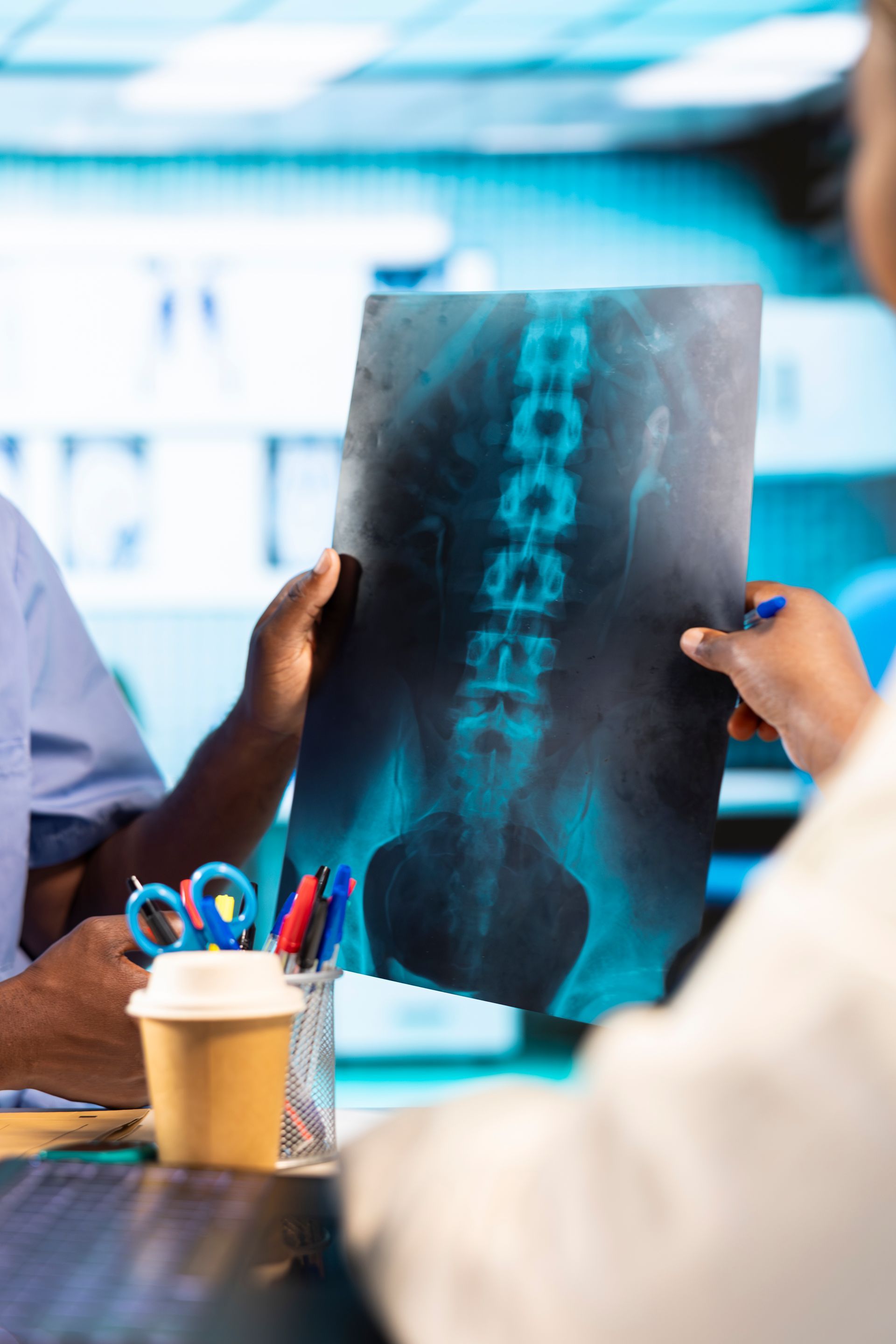
If you've been told a herniated disc or compressed nerve requires surgery, decompression therapy is worth understanding first. We offer non-surgical spinal decompression in Antigo, WI, and we'll review your existing MRI at no charge to tell you whether you're a candidate.
What Spinal Decompression Actually Does to the Disc
Spinal decompression therapy works by applying controlled, computer-guided traction to the spine. That traction creates negative pressure inside the disc — pulling the disc material away from the nerve it's compressing and drawing in fluid, oxygen, and nutrients that support the disc's own healing process. It is not a stretch table. It is a targeted mechanical protocol designed to reduce intradiscal pressure at a specific spinal level.
The treatment is outpatient. No anesthesia, no incision, no recovery period. Patients drive themselves in, complete a session, and drive themselves home. Most sessions run 20 to 30 minutes.
Three Situations Where Patients Come to Us First
Decompression therapy draws patients at very different points in their spine pain journey. Most fall into one of three situations.
You've Been Told You Need Disc Surgery
A surgical recommendation for a herniated or bulging disc is not automatically the only option. Decompression therapy reduces pressure within the disc without any incision, and many patients with disc conditions that appear surgical on imaging respond well to a conservative protocol. We review existing MRI findings at no charge to assess whether decompression is a reasonable path before you commit to a procedure that comes with real recovery time and real risk.
You Already Had Back Surgery and You're Still in Pain
Failed back surgery syndrome is more common than most patients are told before they go under. We treat patients with prior spinal procedures, including those whose surgery did not resolve their symptoms. Candidacy depends on the specific procedure performed, but surgery is not the last stop. If you have imaging from before and after your procedure, bring it. We'll tell you honestly what we're looking at and whether decompression can help.
You Can't Afford Weeks Off Work for a Recovery
Disc surgery typically requires four to six weeks of restricted activity at minimum. Decompression therapy requires none. Sessions fit into a normal workday — some patients come in before a shift or during a lunch break. There is no anesthesia to recover from, no wound to manage, and no activity restrictions imposed after a session. For patients who cannot take extended time away from work or family, the outpatient nature of decompression is not a minor convenience — it's a deciding factor.
How We Combine Decompression with Class IV Laser Therapy
Most clinics offering spinal decompression treat it as a standalone service. We pair it with Class IV medical-grade laser therapy on disc conditions, and the clinical rationale is straightforward. Decompression reduces the mechanical compression on the nerve. Laser therapy at therapeutic depth drives cellular repair in the inflamed tissue surrounding the disc and nerve root. The two work on different parts of the same problem simultaneously.
Our Summus laser operates at 60 watts — the same equipment tier used on NFL and Olympic athletes. This is not the 0.5-watt cold laser common in the region. It delivers energy at a depth and intensity that produces a measurable biological response in the tissue. When we combine it with a decompression protocol on a herniated disc case, we're addressing the structural compression and the inflammatory response at the same time, rather than treating one and leaving the other.
What to Expect: Session Counts and the Pace of Results
Decompression therapy is not a one-visit fix, and we won't tell you it is. Most disc conditions that respond to treatment do so over a course of sessions — typically somewhere between 12 and 24, depending on the severity of the disc involvement, how long the condition has been present, and how the patient responds in the early sessions. We track progress and adjust the protocol as we go.
Results build gradually. Some patients notice a meaningful reduction in leg or arm symptoms — the nerve compression signs — before the back pain itself fully resolves. That's expected. As the disc retracts away from the nerve, the referred pain pattern often improves first. We set these expectations clearly at the start of care so patients know what they're measuring and when.
If you're not responding to decompression after a reasonable number of sessions, we'll tell you. We don't extend care indefinitely on a patient who isn't making progress.
Conditions Decompression Therapy Is Used to Treat
Spinal decompression is primarily a disc-focused treatment. It is most appropriate for conditions where nerve compression originates from disc pathology rather than from bone, stenosis, or structural instability.
Conditions we commonly treat with decompression:
- Herniated or bulging discs in the lumbar or cervical spine
- Sciatica caused by disc compression on the sciatic nerve
- Degenerative disc disease with nerve involvement
- Posterior facet syndrome related to disc height loss
- Radiculopathy — pain, numbness, or weakness radiating from the spine into an arm or leg
- Back pain that has not responded to chiropractic or physical therapy alone
For a more detailed look at how decompression applies to specific conditions, see our pages on herniated disc and sciatica. If you're dealing with general low back pain and aren't sure whether disc compression is the source, the back pain page covers how we evaluate that.
Frequently Asked Questions About Spinal Decompression
Does spinal decompression work for a herniated disc?
It works for many patients with herniated discs, but not all. The right candidates are those whose disc compression is causing nerve symptoms — pain, numbness, or weakness radiating into the leg or arm — and who don't have structural instability or other contraindications. We review your imaging before starting care to assess whether you're likely to respond.Is spinal decompression an alternative to surgery?
For patients who are surgical candidates based on imaging but haven't yet had the procedure, decompression is a legitimate conservative option to try first. It doesn't work for every disc condition, but it avoids the risks and recovery time of surgery for those who do respond. We offer a free review of your MRI so you have an honest assessment before committing to either path.How many spinal decompression sessions do I need?
Most patients with disc conditions complete between 12 and 24 sessions. The number depends on the severity of the disc involvement, how long the problem has been present, and how your body responds early in the protocol. We track your progress throughout and don't extend care beyond what's producing results.Can I get spinal decompression if I've already had back surgery?
In many cases, yes. Candidacy depends on the specific procedure you had — some prior surgeries are compatible with decompression and some are not. If you bring your surgical records and any post-operative imaging, we can evaluate your situation and give you a direct answer.What does spinal decompression cost in northern Wisconsin?
We publish our pricing transparently. Call or visit the pricing page for current session rates. We do not require a long-term package purchase to begin care, and we accept cash-pay patients directly without requiring insurance billing.
Start with a Free MRI Review — No Commitment Required
If you have existing imaging — an MRI, a CT scan, a surgical report — bring it. We review it at no charge and give you a plain-language assessment of what we're looking at and whether spinal decompression is a reasonable next step for your situation. If it's not, we'll tell you that too. We also offer second opinions on disc-related surgical recommendations for patients who want an independent clinical perspective before deciding.
If you're coming from Wausau, Merrill, Rhinelander, Tomahawk, or the surrounding area, we see patients from across northern Wisconsin and the scheduling process is straightforward.